
Why Queer Media Still Matters More Than Ever
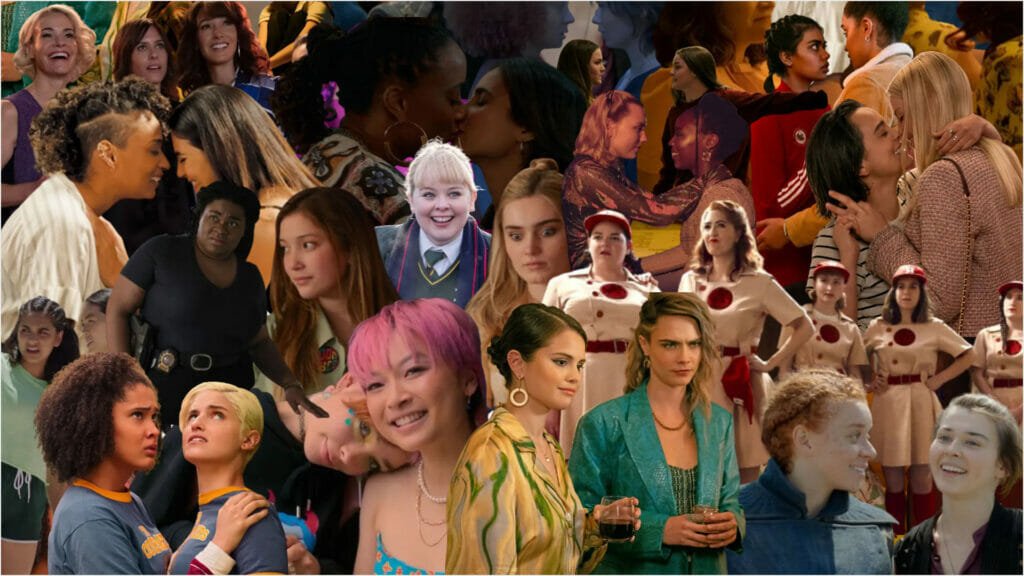
Photo Credit: GLAAD
Have you ever stopped to think about how powerful representation really is?
For decades, mainstream media has shaped how societies see the world — and who gets to exist within it. But for many people across the LGBTQ+ community, that mirror has often been distorted.
Lesbian characters written as jokes. Queer women erased from stories. Trans lives reduced to tragedy. Representation has rarely been fair.
And when you grow up without seeing yourself reflected — without seeing a lesbian heroine, a queer artist, a woman loving another woman simply living her life — something important is missing.
That is exactly why queer media exists. Queer media is not just entertainment.
It validates identities. It educates audiences. It pushes back against prejudice in a world that is still deeply heteronormative.
When a young LGBTQ+ sees it self on screen, internet, newspaper it sends a message that changes everything:

You exist.
You matter.
Your story belongs here.
©Kampus ProductionThis is also why spaces dedicated to LGBTQ+ storytelling remain essential today.
In January, Helsinki hosted the fifth edition of The Queer Gala, a celebration recognizing individuals and projects that amplify queer voices in Finland. In the category Queer Media of the Year, the award went to a project that is quietly building something powerful:
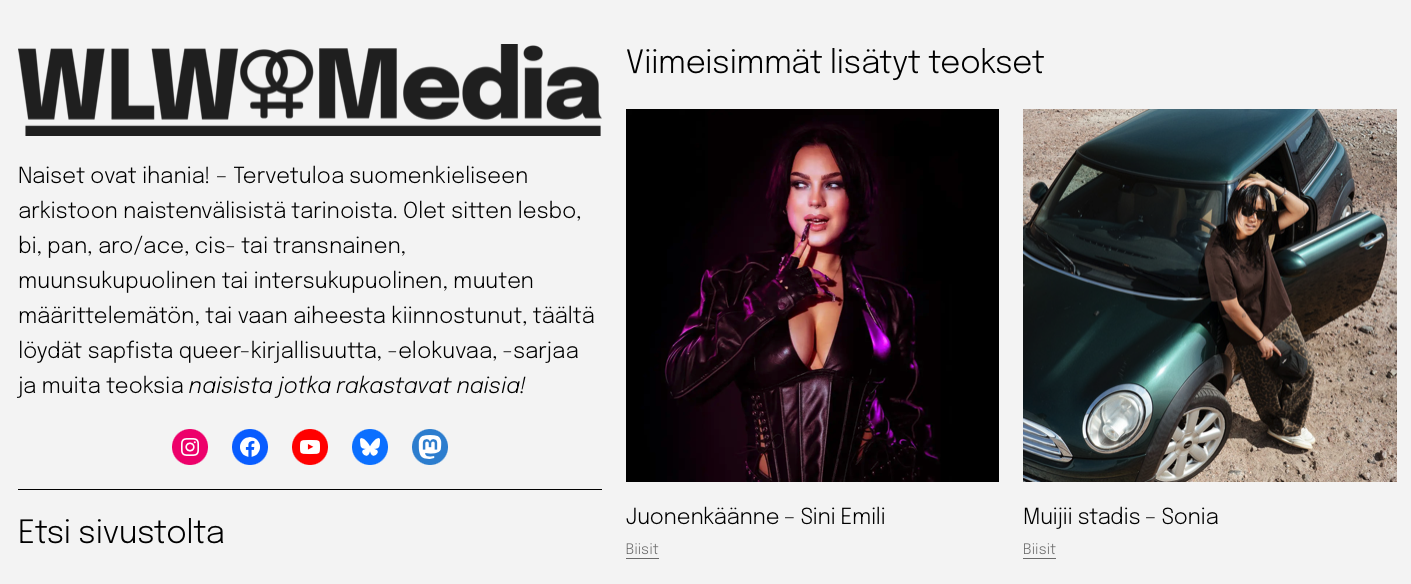
WLW Media from Finland
Check the website here: WLW Media and instagram here WLW Media
A Finnish Platform Dedicated to Women Who Love Women
WLW Media is built around a simple but deeply meaningful idea: everyone’s voice matters.
The term WLW stands for Women Who Love Women, an umbrella concept broader than traditional labels. It includes lesbian women, bisexual women, pansexual women, nonbinary people connected to womanhood, and a wide spectrum of sapphic identities.
The project was created to solve a very real problem.
Many LGBTQ+ films and series recommended by streaming platforms promise queer representation — yet often the only female character who loves women appears briefly, suffers, and disappears before the story even reaches its end.
And when it comes to literature? Stories about gay men dominate the shelves, while lesbian and sapphic narratives remain far less visible.
Even more challenging in Finland: much of the existing queer media discussion happens in English, and not all international content is accessible locally.
WLW Media set out to change that. The platform reviews films, books, series, music, and other media featuring queer women — building what is slowly becoming a cultural archive of sapphic storytelling in the Finnish language.
But behind every powerful platform, there is always a story.
And behind WLW Media, there is Maria.
The Woman Behind WLW Media
Maria did not start WLW Media as a media entrepreneur. She started it because she needed it herself. In 2019, at the age of 38, Maria realized something that many people spend their entire lives trying to understand: she was not straight.

“There are many ways to be a lesbian, and not just one.”
Maria- Founder of WLW Media
©Tanja Mäenpää PhotographyFor many queer people, identity discovery happens in teenage years. For others, it arrives later — quietly, unexpectedly, but with clarity. Maria describes herself as a “late bloomer.” And with that realization came something many queer women experience: searching for stories that mirror your own life.
Stories of lesbian women.
Stories of queer relationships.
Stories of people who discovered themselves later.
But finding those stories was difficult. Most lists existed only in English. Many books were unavailable in Finland. Films recommended online often could not be legally watched in the country.
And language matters deeply when exploring something as personal as identity.
Maria already had a background in IT, web development, marketing, and graphic design. She had run her own business building websites.
So she used the tools she already had.
And WLW Media was born.
“If even one person finds themselves through these stories, it was worth it.”
QM.- WLW Media was born from a very personal place. When you look at the platform today, what moment makes you feel, “This is exactly why I started”?
Maria:
Mostly the support I get from readers, followers and our volunteer writers is what inspires me to keep going, even when it feels lonely sometimes. If there is even one single soul, who got help in recognizing her/their identity with the stories of this archive, then it has been worthwhile. I am glad the archive has already grown so far, even though I sometimes struggle to find time to write new content.
A Recognition That Proved Queer Media Matters
In a digital landscape dominated by algorithms, visibility can be difficult — especially for independent queer projects. That is why the recognition WLW Media received earlier this year was so meaningful.
Winning Queer Media of the Year at The Queer Gala in Helsinki was more than an award. It was validation.
QM .- Winning Queer Media of the Year at The Queer Gala in Helsinki is a powerful recognition. What did that award mean to you — not just professionally, but personally, as a queer woman who once struggled to find her own reflection in media?

©The Queer Gala
Maria:
Winning the award left me in total amazement. Firstly, getting nominated in the first place was a huge excitement. Until that point I thought that the project had been going widely unnoticed by the masses. As many can surely relate, it is hard to get the word out in the age of algorithms and doomscrolling without a budget for paid advertising. Being nominated in a category with such great established names in Finland’s queer community was just huge. I mean come on, ranneliike.net has been going strong since 2001, for over 25 years!
When I heard that WLW-Media had actually won the category, I was just in awe. The feeling that someone, and not just one, but many have seen my project and deemed it worthwhile, left me just deeply grateful. It is truly needed that we have such events as The Queer Gala, we still need the recognition that we are queer and we are here. Always have been and not going anywhere.
I am also part of the organizing team of Jyväskylä Pride, and still up to this day, we face backslash because we want to be seen and recognized as human beings. So visibility in the media is still important, I think more recently than before, with the rise of anti-gender movements and narrowed viewpoints on women’s rights.
Discovering Yourself Later in Life
One of the most powerful parts of Maria’s story is something rarely discussed: late identity discovery.
Many people believe sexuality must be understood early. But for many lesbian and queer women, identity unfolds later — after years of silence, assumptions, or social expectations.
Maria’s experience shaped the very foundation of WLW Media.
QM.- You realized your identity at 38 — something many people would call a “late blooming” experience. How has discovering yourself later in life shaped the way you build WLW Media today?
Maria:
Maybe the project wouldn’t have been created in the first place, or maybe it would have looked very different, had I realized earlier on who I am. Hard to say, I try to stay away from what ifs and maybies. I do believe that everything we encounter in life, the difficult and the good things, the people who hurt us or those with whom we grow, shape us to those who we are today.
But realizing that I love women so “late” in life certainly was the driver for this project. Even if I try not to think about the what if’s, I am certain that if I would have the representation of lesbians in my early teens like it nowadays begin to be present in the media, I wouldn't have taken so long to find myself.
As in my early teens I could not see myself as an lesbian, as I thought lesbians are those stereotypic masc butches riding a motorbike. I would have needed representation of the diversity the wlw-community has. That there are many ways to be a lesbian, and not just one.
Why Language Matters in Queer Representation
Another essential part of WLW Media’s mission is linguistic accessibility.
Queer representation is powerful — but it becomes even more powerful when people can experience it in their own language.
QM.- Representation in one’s native language can feel radically different. Why was it so important for you to create a Finnish archive specifically, rather than simply sharing global English-language content?
Maria:
There are a lot of websites and projects in English already… But a lot of this content is not viewable in Finland, if you are using official and legal methods. English language is not accessible to everyone. You need a really good proficiency in the language to be able to understand such complex matters as identity, sexuality, sex and gender, in my opinion.
To mention a few numbers, the WLW-archive has at the moment 139 entries within the categories movies, series, books, comics, music and other. And our to-do list, which contains items to check if they are a fit for WLW-Media, contains 183 rows at the moment. So there is still a lot to do.
Identity is a very complex matter, so it is necessary to be able to hear, read and see stories in one's own language.
Beyond the Archive: Maria’s Life as a Queer Woman
Maria’s life extends far beyond WLW Media.
She is a mother of three, an activist helping organize Jyväskylä Pride, an artist in the making, and currently finishing a qualification in carpentry.
Her life reflects something important about queer women: identity does not define the limits of who we are — it simply adds another dimension to our stories.
QM.- You are a mother, an activist, a partner, a soon-to-be carpenter, and a creative spirit. How do these different parts of your life influence the way you see queer womanhood?
Maria:
Being a mother of course is a big driver for my activism. To hope to make this world a better place for the next generation. We are very fortunate with my partner, that we both have been able to live our lives as queer women without a lot of struggle, my partner as simply being who she is from the beginning, and me by finding myself as such a natural part of my growth. I am very fortunate that the experience of finding my identity in that point of my life felt just so natural. The pieces of the puzzle just clicked together and I felt whole for the first time. For me it wasn’t a struggle, only a relief.
I hope to do activism and contribute also by being an queer women artist… I’d love to do more portraits of queer women as a part of a series.
A Message for Young Queer Women
Maria’s story carries a powerful message for young queer women still trying to understand themselves.

I know it sounds so cliche, but you will survive the struggles. All things will fall into place.
Maria - WLW Media
QM.- If a teenage girl somewhere in Finland — or anywhere in the world — is reading this interview and feels lost, scared to be herself, or unsure of her purpose, what would you want her to hear from you right now?
Maria:
Gosh this is a tough one. I know it sounds so cliche, but you will survive the struggles. All things will fall into place. But I know these are just words, when you are in the middle of all the bad stuff life throws at you, words rarely help. So best is to search for a community. Go out and look for the elderly sapphic women in your area. Actually this is a great idea. We have so many lonely elderly people in Finland, especially those from sexual or gender minorities, we should connect them with the younger ones. We can learn so much from the elder generations and their struggles. We should create events where these generations can meet.
The Future of WLW Media
WLW Media is already becoming something larger than a review platform. It is evolving into a living archive of queer women’s culture. And Maria’s dream goes even further.
QM.- WLW Media already feels like a cultural archive in the making. What is your long-term vision?
Maria:
WLW-Media was built with the possibility to scale beyond Finland. The ultimate dream would be to create a worldwide archive, memorizing the legacy of queer women around the world, to each country their own area with their own language. But this would need partners and funding. Currently I am building the archive on my own with the help of a few volunteers and completely self financed. So if anyone is interested in joining the project, feel free to reach out.
Even with growing representation in film and television, many queer narratives remain invisible. I try to stay as much as offline as I can, and I am not very native in the social media world. The real life community spaces are the most important. We need not just stories online, we also need to be able to connect face to face. To be able to hug each other and talk about our dreams and hopes. But I am very glad that there are other projects taking over this, like Sapphic Space, Utopia and Peaches, but these are all concentrated in the Helsinki area. WLW-Media is open to collaborations with events like this.
QM.- Finally, what kind of stories are still missing?
Maria:
For me especially, the late blooming women are still underrepresented… There are still so many glass ceilings to break, and as long as there are people asking “for what do we need pride-marches”, we need to hear the stories and have the representation of queer women.
Why Supporting Queer Media Matters
Projects like WLW Media remind us of something powerful: Representation is not automatic. It requires people willing to build it. Every archive, every story, every lesbian character, every queer narrative added to the cultural landscape helps someone else feel less alone.
And sometimes, one platform can start a ripple effect that travels far beyond its origin. Maria started WLW Media because she once searched for stories that did not exist.
Today, she is helping create them.
And that is exactly how queer history is written.
Discover More Queer Stories
Explore more interviews, LGBTQ+ culture, and queer storytelling at: queerlandmedia.com Follow Queerland Media on Instagram and access all our platforms through our bio.site.
If you know a story, creator, project, or representation that deserves visibility, we want to hear from you.
Contact us:
hello@queerlandmedia.com
Because queer stories deserve to be told.
And even more importantly — to be remembered.
