
LGBTQ+ Homelessness in Finland: Sari Rantaniemi on the Crisis Hidden in Plain Sight
Finland is internationally recognized for its social welfare system, commitment to equality and succestful efforts to reduce homelessness particularly through its Housing First approach. Yet LGBTQ+ people continue to face housing insecurity, family rejection and barriers to accessing support. Sari Rantaniemi, Executive Director of Sateenkaari-ikkuna, explains why homelessness in the queer community remains largely invisible — and why having a home is about more than having a roof over your head.
By Queerland Media | Interview
A hidden reality behind Finland's image of equality
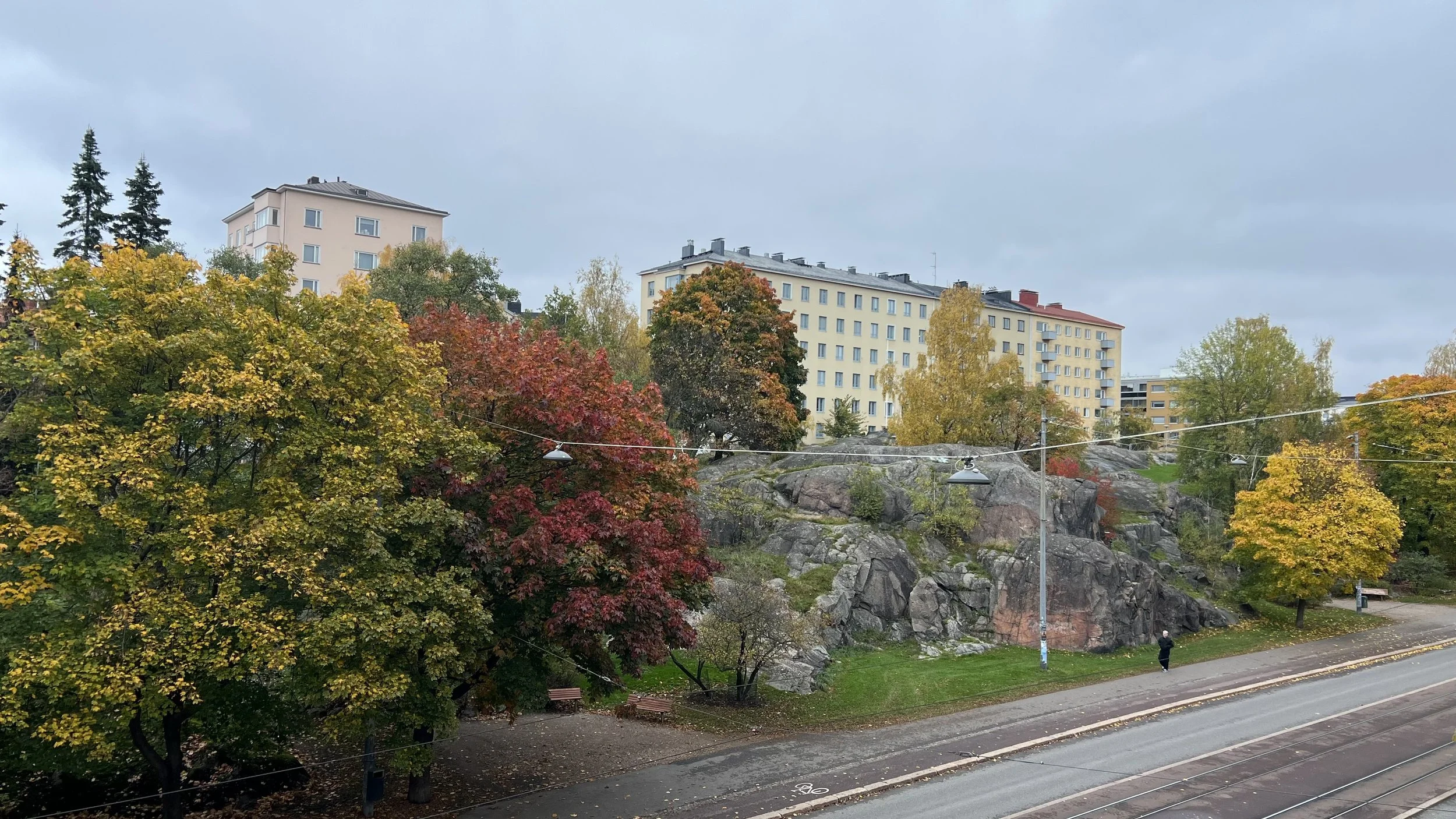
Photo by Raul Medina for Queerland Media
Finland has built an international reputation for social protection, public services and LGBTQ+ rights. But equality on paper does not always translate into safety, stability or a place to call home.
For LGBTQ+ people experiencing homelessness, the reality can be far more complicated than the familiar image of someone sleeping on the street. It can mean spending nights on friends' sofas, leaving an unsafe family home, facing rejection from landlords or remaining in an unstable living situation because there is nowhere else to go.
These experiences are often described as hidden homelessness: housing insecurity that remains out of sight and may never appear in official statistics.
In Finland, the scale of homelessness is becoming harder to ignore. After more than a decade of successfully reducing homelessness in Finland has started to rise again. The figures, collected from municipalities by the Centre for State-Subsidised Housing Construction, also show that 761 people experiencing homelessness were under the age of 25. The national figures do not identify how many of these individuals are LGBTQ+.
For queer people, this lack of specific data is part of the problem. Without a clear picture of their circumstances, their experiences can be overlooked in policies and services that are intended to support everyone. Source: Finland's official homelessness statistics, 2025.
Sateenkaari-ikkuna, a Finnish LGBTQ+ organization founded in 2022, is working to change that. The organization supports LGBTQ+ people who are experiencing homelessness or are at risk of losing their homes, while advocating for greater recognition of the specific challenges they face.
A survey conducted by the organization in connection with Turku Pride received 157 responses. According to the findings shared with Queerland Media, 27% of respondents said they had experienced homelessness at some point in their lives. When asked whether LGBTQ+ people face a higher risk of homelessness, 73% believed they did, 25% were unsure and 2% believed there was no increased risk.
The organization has also highlighted figures suggesting that one in five LGBTQ+ people, and as many as one in three transgender people, experience homelessness or are at risk of it (source: ilga-europe.org). These figures must be understood within the scope of the organization's research rather than as a national estimate of the entire LGBTQ+ population.
Still, the findings raise an urgent question: what happens when the people most in need of support are not even recognized as part of the problem?
Queerland Media spoke with Sari Rantaniemi, Executive Director of Sateenkaari-ikkuna, about the realities behind the numbers, the experiences of LGBTQ+ young people, the limits of conventional support systems and the importance of building a community in which nobody is left behind.
"Homelessness is not only about being on the streets"
Picture by Heini Salo
QM: Tell us a little about Sateenkaari-ikkuna.
Sari Rantaniemi: Sateenkaari-ikkuna is a rainbow organization founded in 2022 that works with LGBTQ+ people experiencing homelessness or the threat of it. Our purpose is to make the specific risk of homelessness among LGBTQ+ people visible and to support them during and after homelessness, as well as prevent it from happening in the first place.
Homelessness is not only about being on the streets. The threat of homelessness and many different life situations are also connected to it.
When I founded the organization about four years ago, it actually started in my kitchen. I had been working in the homelessness sector for a larger organization, talking about how a particular minority group was completely missing from discussions about homelessness. However, I wasn't able to secure funding for this work at the time.
At first, I was disappointed that this work hadn’t started early within another organization. But now I’m happy because I understand that we need Organisations like ours, not just a single project. So we started our own Organisation.
We still lack resources and funding, and there is only so much we can do, but the need is there.
We work at the intersection of homelessness, substance use and other challenges, alongside LGBTQ+ identity. The people we work with may also belong to other marginalized groups. Some have migrated to Finland from other countries, and some are disabled.
These are my observations from the people I know and work with, rather than statistical conclusions. And of course, not everyone experiencing homelessness has experienced long-term homelessness or substance use. People’s situations are very diverse.
We do advocacy work with social services, homelessness service providers and the wider community. Many people understand that homelessness and housing difficulties exist within the LGBTQ+ community, but I've also seen that some find it difficult to recognize or talk about them openly.
People have joined our activities saying they are interested in the topic, but that it doesn't concern them personally. A few weeks later, they might tell us they have been sleeping on a friend's sofa. There can be many things behind that.
The problem is bigger than the picture we have of homelessness
QM: Do you think people are sometimes ashamed to admit they are experiencing homelessness?
Sari Rantaniemi: I think that might be one reason. There can be pressure to be like everyone else.
But I also think the image of homelessness in Finland plays a role. People often imagine a middle-aged man living on the streets and struggling with alcohol. The reality is much more varied than that image suggests. People working in the homelessness sector may recognize the different situations, including youth homelessness and women's homelessness, but not everyone recognises LGBTQ+ homelessness.
When we only recognize one image of homelessness, we risk overlooking people whose experiences don't fit it.
Why is LGBTQ+ homelessness still so invisible?
QM: The data shared by Sateenkaari-ikkuna suggests that one in five LGBTQ+ people in Finland experiences homelessness or is at risk of it. Why does this crisis remain so invisible to the general public and even within our own community?
Sari Rantaniemi: There may be many reasons. One thing that comes to mind is that our community is very diverse. There are also different bubbles within it. Some people are in better situations, while those who are struggling may not have the energy to talk about their experiences.
I also think that, over the years and decades, much of the focus has been on other important issues. When I travel or meet organizations across Europe and around the world, I see how different communities prioritize different needs. In some places, for example, much of the focus is on securing legal gender recognition for trans people.
That might be one reason, but I think there is also something affecting both the community and the services intended to support it.
In Finland, we have a welfare system, and there is an assumption that one model works for everyone. When I started working on women's homelessness about eight years ago, it was still a relatively new topic. Some people said there was no need for specific work on women's homelessness because the existing model was supposed to work for everyone.
I think we can see a similar problem here. If we assume that one system meets everyone's needs, we may fail to recognize the specific barriers faced by LGBTQ+ people.
There are a few organizations in Europe working on LGBTQ+ homelessness. We have collaborated with organizations in Ljubljana, Slovenia, as well as in Italy and Spain. As far as I know, there are no other organizations that carry out this work specifically in the Nordic countries. For now, Sateenkaari-ikkuna is the only one.
Opening a window to safety
Picture by Heini Salo
QM: Sateenkaari-ikkuna translates into English as "Rainbow Window." What kind of window of opportunity are you trying to open for the people you support?
Sari Rantaniemi: The idea behind the name is that, when you have a home, you have a window. You can look outside from your kitchen window, for example, while you are safe inside.
It is the opposite of being out on the street, looking in through a window and seeing warmth, families, security and food.
That is the basic idea behind the name.
Building a community where everyone belongs
QM: Has the LGBTQ+ community itself supported Sateenkaari-ikkuna? And how can people get involved?
Sari Rantaniemi: When people in the community hear about what we do, they usually tell us it is a very good project and that the work is important. So there is support for this issue.
But there are also people who are in better situations and may have different values. Stigma can be a challenge, for example, when it comes to people who use drugs. I always say that they belong to our community, too. They are part of our family.
These challenges are not necessarily present in every activity we organize, but people dealing with these intersecting issues can face the same stigma and hatred that exist in society more broadly.
One of our core values is that everyone should be able to join us as they are, with whatever resources and capacity they have. If someone can only participate in one activity, that is completely fine. We always try to put this value into practice as well as we can, depending on our own resources and capacity. We often feel that we cannot do enough, and we don't always succeed as well as we would like to, but it is something we really want to achieve.
Based on my own experience—Sari Rantaniemi added—and on what trans people have told me, homelessness is often linked to the breakdown of family relationships. For instance, parents may find it difficult to accept that their child is trans.
Trans people face particular barriers to housing
QM: The figures shared by the organization suggest that one in three transgender people experiences homelessness or is at risk of it. What specific systemic barriers do trans people face in Finland?
Sari Rantaniemi: The basic figure we refer to is that one in three transgender people experiences homelessness or is at risk of homelessness. It is important to understand that this includes the threat of homelessness, not only people who are already homeless. It is a huge number.
Social and body dysphoria can also limit people's opportunities in life. They may not be able to study or find employment in the same way as others. For some trans people, transitioning can also mean losing things that were important in their lives, such as relationships or support networks.
Trans people may also face discrimination in the housing market and in services. Often, it is about many different difficulties building up over time. Trans women are in a particularly vulnerable position, but it is also important to recognize the experiences and needs of trans men and non- binary people when discussing homelessness.
In this context, I often talk about minority stress, which is caused by society's norms and expectations, and how it affects the well-being of trans people.
When home is no longer a safe place
Picture by Heini Salo
QM: You work closely with young people facing homelessness. What is the biggest challenge for queer young people trying to find a home in Helsinki today?
Sari Rantaniemi: Not always, but in many cases, the roots of homelessness, housing difficulties or substance use problems can be found in childhood or adolescence.
Perhaps you haven't received enough support from your family. Or perhaps it is difficult for parents, or for people living in smaller towns, to meet and understand LGBTQ+ people. This can have an impact in Finland, too. Some parents do throw their children out. It happens. I've also met people whose parents told them, when they turned 18, "Okay, it's time to go."
There can also be violence or a situation at home that becomes so hostile that a young person has to leave. Whether someone is explicitly told to leave or feels they can no longer safely stay, the result can be the same.
When young people move from a smaller town to Helsinki, they don't always have the support they need to navigate the housing system. They may not know the basic steps involved in finding an apartment, especially if they don't have an education or a job.
It is difficult, particularly when social security is limited and rents are high.
Discrimination can also happen in the private rental market. A young trans woman looking for an apartment may lose out to another applicant because of discrimination. We don't have sufficiently detailed statistics on this, but it is something we need to recognize.
Housing First: a strong model, but is it enough?
QM: Finland is internationally known for its Housing First model. Where does the system fall short when it comes to the needs of LGBTQ+ people and other intersecting identities?
Sari Rantaniemi: I'm a big supporter of Housing First. It is one of the reasons Finland has been able to reduce homelessness to such low levels over many years. The idea is that housing is a human right. If someone is homeless, you provide them with a home, and you also provide support if they need it.
The support should be flexible enough to meet individual needs, although we understand that these systems have certain structures. There may be housing units where several people live together, but these are not always experienced as safe by LGBTQ+ people. Alternatively, a person can have their own rented apartment and receive support at home. I think that can be a very good option for queer people.
I recently attended a Housing First training where we discussed different methods used in this work, including community, the importance of peer support and people's personal growth and development. I think it would be important to provide people working in Housing First with more information and understanding of what peer support and community can mean for LGBTQ+ people. Personal growth, strengthening one's identity and finding one's place in society may also involve different needs and experiences for LGBTQ+ people.
With more knowledge and understanding, workers can be better supported and encouraged to take these things into account when supporting LGBTQ+ people.
Read more about House First HERE.
The challenge of keeping the doors open
QM: What is the biggest challenge facing Sateenkaari-ikkuna as an organization — something our readers should understand?
Sari Rantaniemi: We've been doing this work for four years, and there have been ups and downs. We have received funding, but sometimes only for one year at a time. We have also lost funding due to circumstances beyond our control.
For example, when Donald Trump became president and cut USAID funding, our project partner in North Macedonia lost its funding and eventually had to close down. As a result, we were unable to carry out our joint project and lost its funding as well. This is one concrete example of how the growing hostility towards LGBTQ+ people is affecting our work.
We want to do this work in a way that reflects our values. If we offer support, we have to be able to provide it. The people we work with have often experienced situations in which they were promised things, only for the doors to close again.
We don't want to do that. We want to be honest about what we can offer.
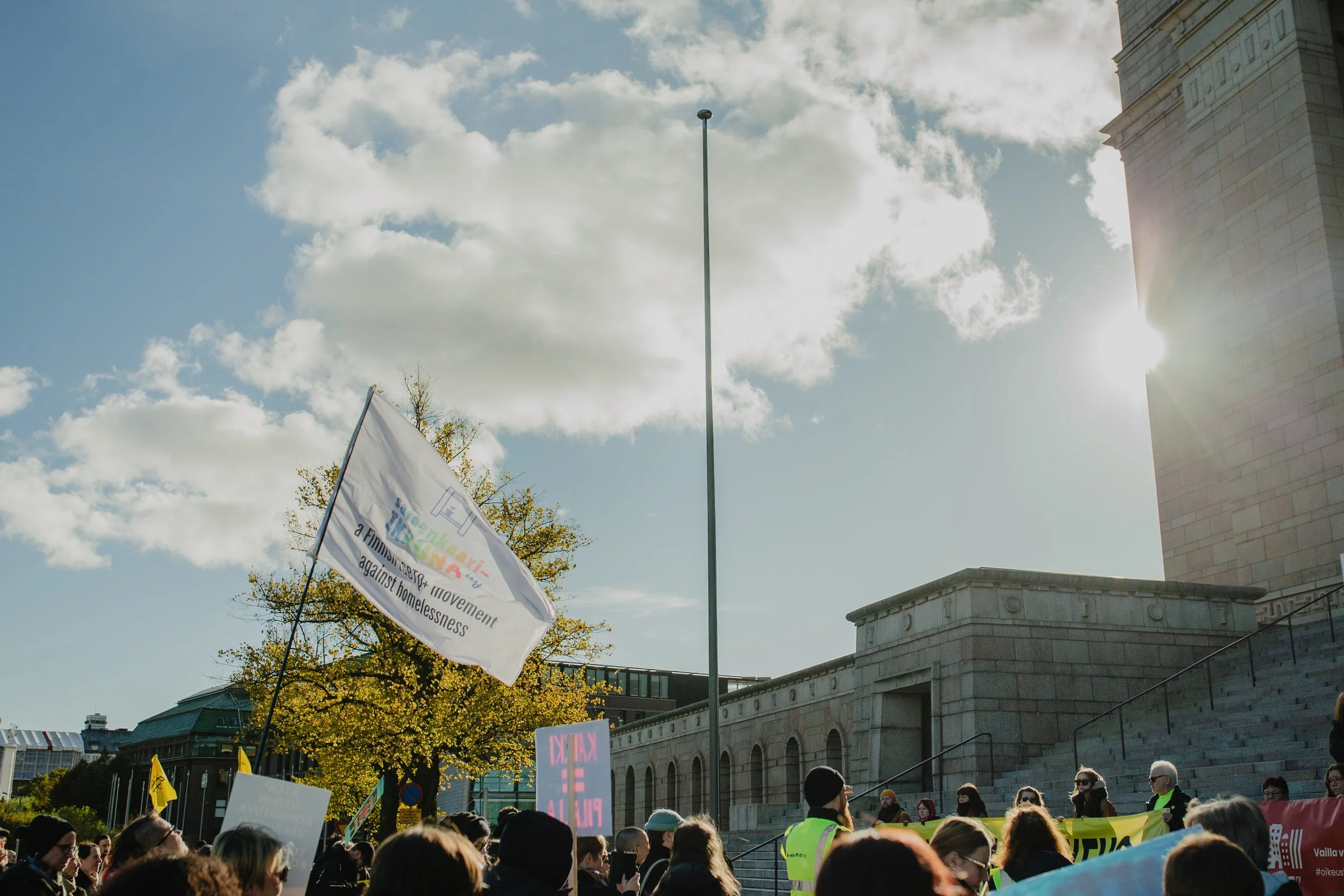
Picture by Heini Salo
As a small organization, it can also be difficult to work with larger organizations. They have their own structures and ways of operating. We need support and would like to collaborate with different peer groups, activists and organizations, but building these connections also takes time and resources.
Many of us involved in this work also have personal experiences connected to these issues. I'm also a queer person, and I haven't experienced homelessness. However, my housing situation was at risk when I was drinking heavily. I was fortunate to have a partner, family and friends who helped me. I got sober before Sateenkaari-ikkuna was founded, and I've been able to enjoy a good life in sobriety ever since. So, as the executive director, I also have a personal connection to this reality. I have experienced how difficult it can be to access certain services, and how inaccessible and unsafe they can be for LGBTQ+ people. When the issues we work with also affect us personally, there
is a risk that this work can take a lot of energy and affect our well-being. At Sateenkaari-ikkuna, we have also faced serious harassment for years, much of it directed at me personally and at people close to me.
The situation has been difficult, but I'm not going to stop working for my community. Of course, this is also my job, but I do this work because I want to. It is my way of giving
back to the community for everything I have received from it. I also know that we should talk more about who can join us and what our organization is. Our activities are not only for people who are currently experiencing homelessness. They are for our entire community. We really need more people to get involved who are in a more stable place in life and who want to support community members who are going through difficult times.
"You are not the problem"
QM: What would you like to say to LGBTQ+ young people experiencing homelessness who feel invisible, alone or disconnected from their families and society?
Sari Rantaniemi: We are here for you. And I don't just mean our organization. Our LGBTQ+ community is here for you, too. We have looked out for one another for years and decades, and we will continue to do so. We are here for you.
If someone has a problem with your gender expression or sexuality, it is not your fault. You are not the problem. Usually, it comes down to other people's attitudes.
If you are experiencing homelessness or discrimination, that is a systemic failure. Homelessness is a life situation, not your identity or who you are. It does not define you. It is a living situation, however difficult it may be.
I remember speaking about this topic at an event for trans people a few years ago. Afterwards, a young trans man came up to me and told me that he had lived on the streets and gone through the child welfare system when he was younger. He had believed that being homeless was his fault. He thanked me for speaking about it because he had finally understood that other people had gone through similar experiences, too, and that it wasn't his fault.
That is something I want people to understand.
Peer support: finding someone who understands
Sari Rantaniemi: Drawing on my own experience as a recovering alcoholic, I know how important peer support can be. I need and value support from another queer person who understands what it is like to be an alcoholic — someone who feels close to you, like a true friend.
That is something we want to offer. We do this through events and other activities, although perhaps we should talk more about it. Some people might simply follow us on Instagram and find a form of peer support there, too.
Sometimes, knowing that someone else understands what you are going through can make a real difference.
Who knows where to turn for help?
QM: How well do you think the LGBTQ+ community knows about your work? If someone is at risk of homelessness or is already experiencing it, do they know they can contact you before trying to navigate conventional services alone?
Sari Rantaniemi: That is a good question. Because we are a sub-organization of Seta, I believe we are known to other organizations in the network. We have more than 1,000 followers, which I think is quite positive for an organization of our size. But I know there are still people who don't know we exist.
We have noticed that there are also many independent collectives and groups within the LGBTQ+ community that operate outside established organizations. They may not necessarily know about the work of NGOs, may feel hesitant to approach them, or simply prefer to remain independent and that is completely fine. I think it is important to build connections with these groups, so that we know about each other and can work together when it makes sense.
Especially this year, we have also recognized a growing need to share information about our work and the services available in Finland with LGBTO+ community members who do not speak Finnish.
QM: Do conventional homelessness organizations understand the specific challenges faced by LGBTQ+ people?
Sari Rantaniemi: There is a lot of expertise in the homelessness sector, and we have some really good allies working there. At the same time, LGBTQ+ homelessness is still not a familiar topic for all professionals, and there is a need to raise awareness, not only in the Helsinki metropolitan area but also in other parts of Finland. This work cannot depend only on individual contacts. To make a real difference, it needs to be done more systematically. But our limited resources and capacity also affect how much we can do. Another challenge is the current situation in Finland. Political decisions have increased people's need for support while significantly weakening the resources available to NGOs.
Many organizations working with people experiencing homelessness are struggling just to maintain their existing activities. I understand how difficult the situation is, but we are always open to collaboration. One thing I would also like to challenge is the idea that recognizing the specific needs of LGBTQ+ people means, asking for special treatment. That is not what we are asking for. It is about making sure that everyone's individual needs are genuinely understood and met, and that services are safe and accessible for all.
When we focus only on saying that everyone is treated equally, we can easily overlook the different barriers people face when trying to access services or when using them..
Making the issue visible — and building connections
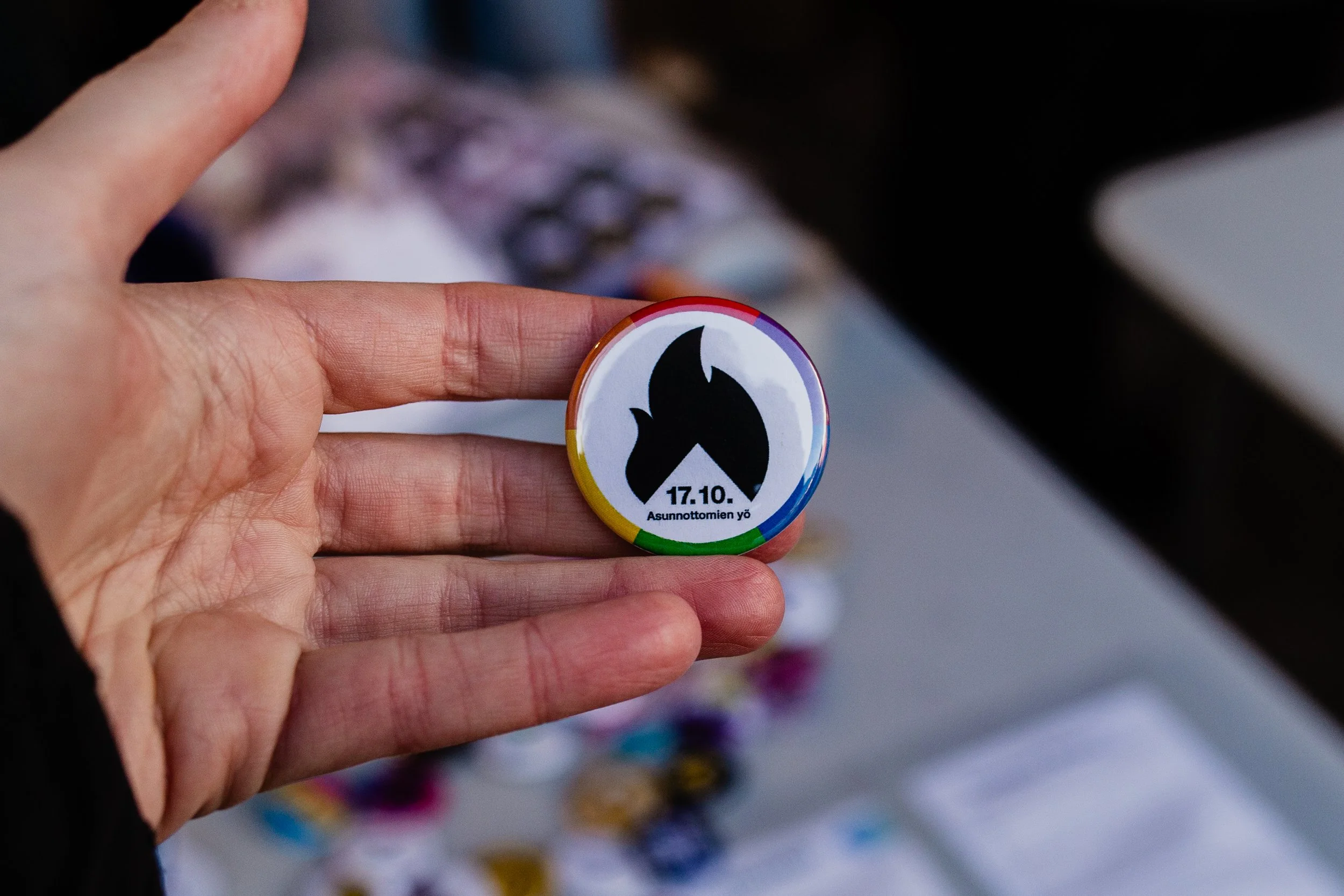
Picture by Heini Salo
Sateenkaari-ikkuna shares information about its work and activities through social media, with a focus on building community and creating opportunities for people to connect.
Rantaniemi also wants the organization to strengthen its relationships with the wider homelessness sector. Reaching people who do not identify with conventional homelessness services, or who may not feel comfortable approaching them, is an important part of that work.
One opportunity to bring the issue into the public conversation is Asunnottomien yö, Finland's annual Night of the Homeless event, held on 17 October. In 2026, the main event in Helsinki takes place at Kansalaistori, with more than 30 organizations and other stakeholders expected to participate. The programme includes expert talks, personal testimonies, conversations with members of parliament, music, poetry and food. Event information: Asunnottomien yö.
For Sateenkaari-ikkuna, participation in these networks is a way to connect with other organizations, share knowledge and make LGBTQ+ homelessness more visible within the wider discussion about housing insecurity.
Funding remains a major concern. As the organization looks towards 2027, Rantaniemi hopes to secure the resources needed to sustain its activities and strengthen its collaborations.
International connections are also important to Sari Rantaniemi. Organizations working on similar issues across Europe can share experiences, learn from one another and find the resilience to continue, even when resources are limited.
A home should mean safety, dignity and belonging
The experiences described by Sari Rantaniemi challenge the assumption that a strong welfare system automatically meets everyone's needs.
A person can have access to public services and still struggle to find safe housing. A young person can leave an unsafe family home without the knowledge or resources needed to secure an apartment. A transgender person can face discrimination in the rental market. Someone living with addiction can find that the very services designed to help them do not feel safe or inclusive.
These experiences are not interchangeable, and no single survey can capture the full scale of LGBTQ+ homelessness in Finland. But they point to the importance of collecting better data, recognizing intersecting barriers and ensuring that support is accessible to the people who need it.
Sateenkaari-ikkuna's work is a reminder that homelessness cannot be understood only by counting the people sleeping outdoors. It also requires listening to those who are staying temporarily with friends, leaving hostile homes or living with the constant fear of losing their housing.
For Rantaniemi, the answer begins with a simple principle: LGBTQ+ people should not have to leave their identity at the door to receive support.
And for young people who have been made to feel that their circumstances are their own fault, her message is equally clear: you are not the problem, and you do not have to face this alone.
Because a home should be more than a place to sleep. It should be a place where you can feel safe, accepted and free to be yourself.
About Sateenkaari-ikkuna
Sateenkaari-ikkuna is a Finnish LGBTQ+ organization founded in 2022. It works to raise awareness of homelessness and housing insecurity among LGBTQ+ people, provide community-based support and advocate for services that recognize the needs of people experiencing homelessness or at risk of losing their homes.
Website sateenkaari-ikkuna.fi
Sources and editorial notes
Sateenkaari-ikkuna: Survey figures and interview statements supplied by the organization and Sari Rantaniemi. The full survey report and methodology should be linked when publicly available.
Finland's Centre for State-Subsidised Housing Construction (VARKE): Homeless People 2025, published in 2026. Official statistics.
Asunnottomien yö: Official information on the annual Night of the Homeless event. Event website.
The survey figures cited in this article should not be interpreted as nationally representative estimates of LGBTQ+ homelessness. The national homelessness statistics do not provide a separate count of LGBTQ+ people.
Got a story to share?
We want to hear from you. Contact our editorial team in complete confidence, or email us at hello@queerlandmedia.com.
We read every message, although we can't promise a personal reply to everyone.
